01
No textbooks. Primary sources only.
We read Euclid, not a book about Euclid. Plato, not a Plato summary. This is education at the source.
A four-year liberal arts program where students read original works, discuss them in small seminars, and connect ideas across the humanities, sciences, and social thought.
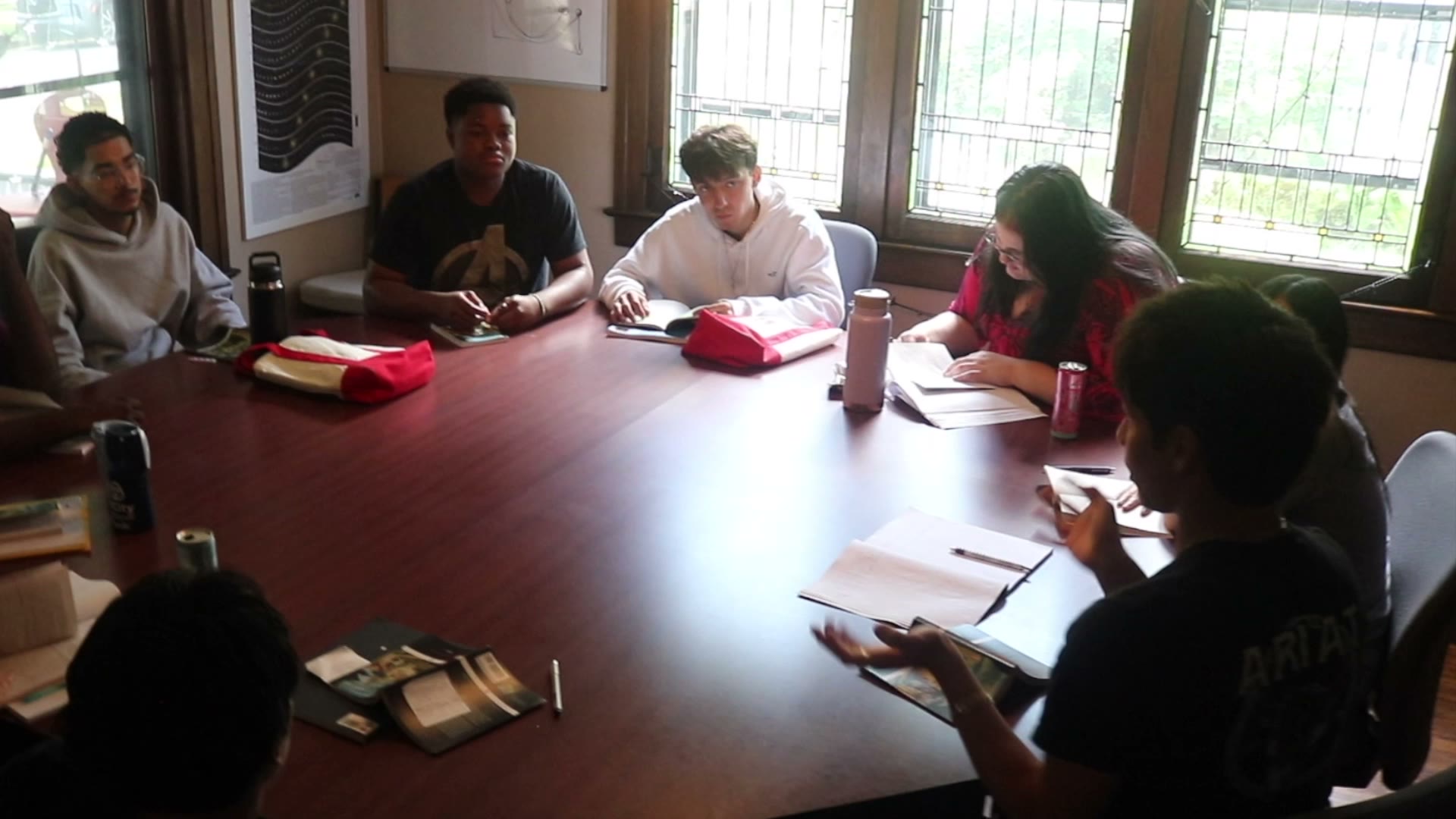
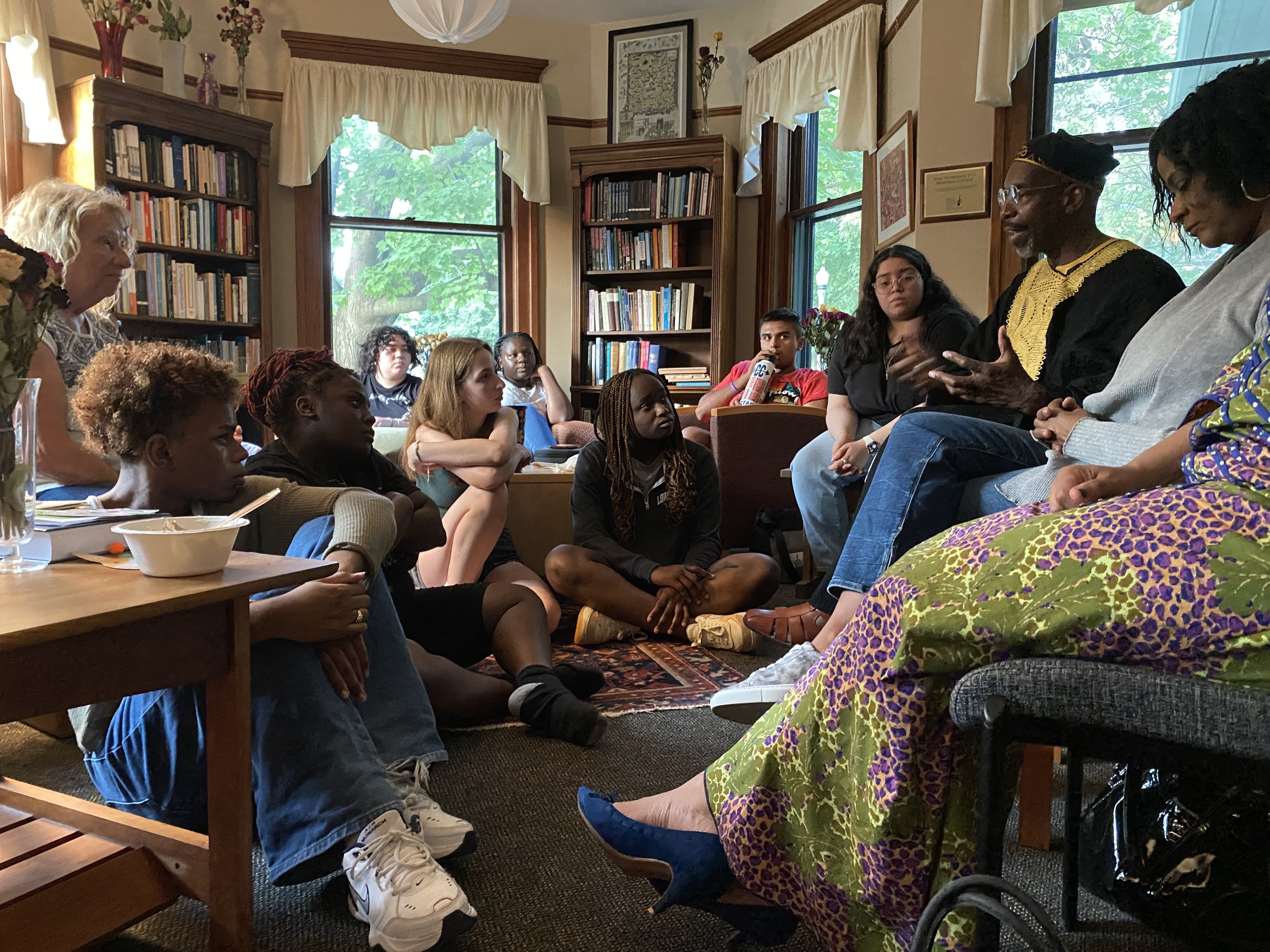
Several current students talk about what studying at Shimer is actually like — the seminars, the reading, and the community.
Get a clear picture of the program, the experience, and your next step—whether you are just discovering Shimer or ready to apply.
Shimer combines an intimate intellectual community with the resources of North Central College. Your seminars provide a shared foundation; electives, a second major, research, internships, and campus life let you shape what comes next.
Build habits of close reading, discussion, mathematics, logic, and interdisciplinary inquiry.
Move among humanities, natural sciences, and social sciences instead of treating them as separate worlds.
Add another major or minor, pursue research, join organizations, and gain experience beyond the seminar.
Complete advanced work and carry the ability to question, reason, and communicate into what follows.
Start with the curriculum, see what is coming up, and meet the faculty who guide seminar conversations.
Alumni keep exchanging ideas, reflections, and community news through a growing bulletin archive.
Quick answers about the program, admission, and cost. For the full list, open the About page.
Admission is through North Central College — let the office know you’re interested in Shimer, and staff will guide you from application to enrollment.
Open North Central College's live room calendar to view public scheduled use of Shimer House, Room H362-03, at 5 S. Loomis Ave.
An open time does not guarantee building access or permission to reserve the space.
Published classes, meetings, and events using Shimer House during the next 30 days. Only verified entries are shown.
An empty period does not guarantee access or availability. Check the official building calendar before making plans.
Shimer students belong to a small Great Books program within the wider North Central College community: close seminars, campus organizations, public events, and shared traditions.
Shimer community life starts in discussion, then extends into campus events, student organizations, leadership, and informal reading and conversation outside class.
Classes are built around discussion, careful listening, and direct engagement with primary texts.
Shimer students have access to clubs, facilities, performances, athletics, and student services at North Central College.
Lectures, symposia, reading groups, and community gatherings give students more ways to keep the conversation going.
Students can enter the Shimer community through seminar, student-led gatherings, public programs, and the wider North Central College network.
Discussion-based classes make it easy to know classmates by name and build habits of serious, generous conversation.
Students can join organizations, performances, service work, athletics, and social events across North Central.
Reading groups, lectures, faculty conversations, and student initiatives extend the questions beyond class.
Student-led groups where Shimer students gather around shared interests, meals, and conversation.
Everything you need to know about our program, curriculum, faculty, and what makes a Shimer education unlike any other.
The Shimer Great Books School at North Central College brings students into direct contact with major works in philosophy, literature, science, history, and the arts, so they can study not just conclusions but the thinking behind them.
Students learn in small seminars where faculty guide discussion, ask hard questions, and help each person connect ideas across disciplines. The program is built around close reading, thoughtful argument, and a shared commitment to learning together.
Every Shimer course is a small seminar built around primary sources — the works that have shaped how we understand ourselves and our world. The course titles below are the enduring questions themselves, studied across the humanities, the natural sciences, and the social sciences.
Each area asks its own questions, but Shimer students learn to follow ideas across the boundaries between them.
Why do we tell stories? Major works of literature, philosophy, history, and the arts — from journeys through art and fiction to music, verse, and drama.
What is the world made of? Through original texts and experiments, students ask what matter, light, and life really are.
What is justice? Political and social thought — authority and freedom, power and statecraft, revolutions — across time and tradition.
Hear how the major and minor are structured, what students read and discuss, and how each path can fit into a North Central education.
A faculty introduction to Shimer’s full interdisciplinary sequence and the experience of studying the humanities, natural sciences, and social sciences together.
A faculty introduction to the related minor, its focus on close reading and discussion, and the ways it can complement another major.
Explore the Shimer seminars offered this semester. Consult North Central College’s official class schedule for current instructors, meeting times, credits, registration details, and any schedule changes.
Compare the Shimer Great Books major with the related interdisciplinary History of Ideas minor. Requirement groups are presented in the order students use them to build each pathway.
The Great Books major comprises the entirety of the School’s core curriculum. Majors take courses in all three areas — humanities, natural sciences, and social sciences — learning to integrate knowledge and methods from disparate fields.
A related interdisciplinary minor of at least 16 credit hours centered on close reading of primary texts and discussion of influential ideas from antiquity to the present.
Elective courses for the major and minor, added here as they're finalized.
There is no separate Shimer application. Apply to North Central College through the route that matches your student type, then tell your admission counselor you want to explore Shimer Great Books.
Use this as the practical sequence. Current deadlines, requirements, and financial aid details should always be confirmed with North Central admissions.
Apply through North Central College using the application option that fits your student type.
Tell admissions you are interested in Shimer Great Books so they can connect you with the right academic information.
Provide transcripts and any required supporting materials listed by North Central admissions.
Schedule a visit, ask about a Shimer seminar, review scholarships and aid, and confirm whether the Shimer B.A. or related History of Ideas minor fits your plans.
Shimer students enter through North Central College. Your admissions counselor can help match the right application route with your academic plans.
Apply as an incoming undergraduate and tell admissions you want to explore Shimer Great Books.
First-year detailsShare prior college coursework so North Central can review transfer credit and advise your Shimer path.
Transfer detailsFind North Central guidance for international, homeschool, veteran, former, and other applicant types.
See every applicant typeBoth options use Shimer’s seminar model: primary texts, close reading, and sustained discussion across disciplines.
The full interdisciplinary program for students who want Shimer to be the center of their college course of study.
A related interdisciplinary minor for students who want to study influential ideas through close reading and discussion alongside another degree program.
First-year, transfer, international, homeschool, veteran, and former students each have official application guidance.
Compare applicant routesShimer students can use North Central financial aid resources, including scholarships, grants, and aid counseling.
Explore tuition and aidA visit is the best way to understand seminar learning, campus life, and whether the Shimer community fits you.
Explore visit optionsRequirements vary by applicant type. Use this list to get oriented, then confirm current materials, dates, and aid details with North Central admissions.
Shimer students extend their seminar work through the Senior Thesis and North Central College’s research, internship, and study abroad programs. The School has also hosted the Civic Humanities Project for high school Freedom Scholars.
Choose opportunities that deepen your questions, test your ideas, and connect your Shimer education to the world beyond the classroom.
Shimer alumni remain part of a community shaped by shared books, serious conversation, and friendships across generations. Reconnect, follow alumni news, and find the resources that keep Shimerians in touch.
Whether you studied in Mount Carroll, Waukegan, Chicago, or Naperville, alumni share a history of inquiry and a community that continues beyond campus.
Shimerians carry the conversation into their work, communities, and lifelong learning—then bring new questions and experiences back to one another.
Alumni bring close reading, clear argument, and intellectual independence into graduate study, careers, creative work, and public life.
The Shimer Great Books Reunion brings alumni back to familiar questions, seminar conversations, and friendships across graduating classes.
Find transcript guidance, career support, alumni events, historical materials, and North Central College’s wider alumni network.
Follow the alumni bulletin and archived Shimer podcast to keep up with community news, events, reflections, and ongoing conversations.
Start with Shimer-specific traditions and records, then use North Central College’s wider alumni network for events, career support, and ongoing connection.
Find reunion information and return to the conversations and friendships that shaped the Shimer experience.
Open resource 02Use North Central’s Shimer-specific hub for historical records, account guidance, and transcript information.
Open resource 03Request an official North Central or former Shimer College transcript through the Registrar’s verified process.
Open resource 04See upcoming North Central alumni gatherings, Homecoming information, and opportunities to return to campus.
Open resource 05Explore North Central career resources and professional-development support available through the College.
Open resource 06Update your profile, submit a class note, find alumni programs, and contact Alumni & Family Engagement.
Open resourceShimer adopted its seminar-based Great Books curriculum in 1950. In the decades since, its graduates have carried those habits into careers across science, politics, the arts, and public life.
Influential political science professor at Princeton University.
Cosmologist known for research on quasars.
Poet and longtime English professor at Tulane University.
Television host and actress.
Chess Grandmaster and author.
Musician and video artist.
Alumni stay in touch through reunions, archived conversations, and resources built for Shimerians.
Ask a question, share an idea, or raise a concern with the Shimer Great Books School. Your note will open as an email draft addressed to the Shimer office, so you can review it before sending.
This website does not submit or store your message. Your email app will open a draft, and the message is sent only after you choose Send.